
Different microphones lend a different tenor to the recording of a cabinet or an environment, so we endeavor to offer you choice—although not every single cabinet or environment will necessarily be recorded with every single mic in the library. You’ll also have different mic positions to choose from, to catch different characters of a given cab/mic combo.
THE MICROPHONES
Shure SM57
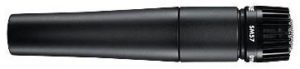
The de facto standard cardioid instrument microphone in clubs and touring rigs around the world, the Shure SM57 is a low-feedback dynamic mic with bright character and tight upper mid-range. If you’ve ever played through someone else’s sound system, chances are you’ve already played through one of these mics.
Shure SM81

This small-diaphragm cardioid condenser microphone is championed for its flat response over a wide frequency range, low distortion and high clipping tolerances. It’s the mic of choice for the heroes over at Audio Sprockets, who recommend it for creating WaveMaps (on-board impulse responses) with their brilliant ToneDexter preamp. If you need your recording to be as colorless as possible, this is the mic to choose.
Earthworks SR314
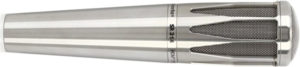
The SR314 is a studio-quality vocal microphone that was designed for live performance, and happens to sound amazing on instruments as well—all while looking like a beautiful art deco billy club. I love a transparent microphone, and Earthworks’ motto for this stainless steel tank is “sound more like yourself”—a more poetic version of MSOL. Crystal clear but surprisingly forgiving, the Sr314 is designed so that there’s minimal proximity effect and astounding consistency of tone all the way up to 90° off-axis.
Slate ML-2 (raw signal plus 18 models)
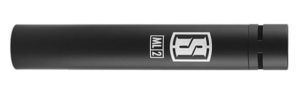
Yes, the ML-2 is a modeling microphone. But without any of the software applied, this miraculous little pencil mic happens to be one of the flattest-response small-diaphragm condenser mics on the market—on par with the SM81 but at a much lower price tag. Since we want you to hear the cabs we’re recording as clearly and transparently as possible, it’s a must-have for our locker. That being said, it’d be a shame not to take advantage of the modeled mics in Slate’s VMS, so we also provide IRs of the (real-world) cabs we’re recording with all 18 software mic models that the ML-2 comes with. Is it weird to use a modeled mic to make an impulse response? Maybe. Will you be able to tell the difference between the sims and the real deal? Unlikely (although I don’t know your life). Either way, it lets us offer you a much wider variety of IR flavors than we’d be able to if we were relying on physical mics alone.
Beheringer C-2
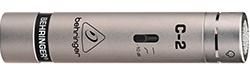
Say what you want about Behringer—I do, frequently—but despite their reputation for making crappy knockoffs of great gear, they do make decent microphones for the money. In this case, the C-2 is a cardioid condenser mic that is generally thought to be a knockoff of the Neumann KM184 but is defended by its fans as being so much more for so much less. The C-2 has the same frequency response as the KM184, but a higher impedance/max SPL/sensitivity; however, it does lack the omni-directional and hypercardioid options that the Neumann offers. Former BBC broadcaster Richard Fairhead invested in these very mics when he went freelance and had to start buying his own recording equipment and found that the mics he’d been using at the World Service were a bit dear for his budget.
Audix D2

The D2 was designed to pick up everything from drums to amps to brass & woodwinds. Its acolytes most frequently compare this dynamic hypercardioid mic to the legendary Sennheiser MD421, saying the D2 has slightly less presence but a cleaner, more transparent sound with tighter lower-midrange. Its high SPL makes the D2 great for percussive instruments or string players who have a heavy attack (slappa da bass?), and it’s got a unique combo of clarity and warmth that really translates well into reproducing how your ears hear your instrument acoustically.
Blue Electronics Yeti

At one time the gold standard of podcasters’ microphones, the Blue Yeti was one of the first USB-only microphones that took audio quality seriously. Although its position may be dethroned now that companies like AKG and Rode are finally making USB mics, if you’ve ever listened to a podcast you’ve probably heard someone’s voice through a Yeti. It is also marketed to and used by musicians, most notably guitar phenom Yvette Young who appears in advertising campaigns for the mic. It’s known for clarity and transparency, and sports onboard gain/volume controls and headphone monitoring. But the Yeti’s secret weapon is its ability to switch through stereo, bidirectional, cardioid and omnidirectional pattern modes at the flick of a dial. The mic is so sensitive that one of the biggest complaints about it is that it picks up too much environmental sound, although that very feature has made it popular in the ASMR community.
Electro-Voice EV-666
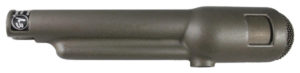
The EV-666 microphone is the great-granddaddy of Electro-Voice’s popular RE-20. This vintage mic might be a little low-fi and boxy compared to its modern descendant, but the EV-666 is known for stellar background noise rejection, excellent midrange, and good bass response when positioned close to the audio source. It was designed as a public broadcast mic (it was used in White House press conferences through several Administrations), but it’s been used as a drum mic by luminaries such as Jon Bonham and Charlie Watts and as a vocal mic by the likes of Aretha Franklin, Elvis Presley, Johnny Cash and George Benson. It’s also appeared on tracks from more recent artists such as Kendrick Lamar and the occasional metal band that feels compelled to use it because of the model number.
Electro-Voice 607
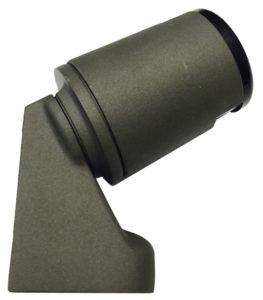
The EV-607 is a close-talking noise-cancelling feedback-busting vintage microphone that is a favorite of harmonica players for those very traits, plus the fact that its small form factor can be easily cupped in the hand. Its low-impedance design provides an articulate high gain response, which also makes it a good option for singers or MCs who like to eat the mic when they perform. Manufactured in the ’60s and ’70s and marketed as a “general address” mic for paging systems, it comes with bonus shame—all you Boomers and GenXers were probably summoned to the principal’s office on one of these babies.
Turner 33D
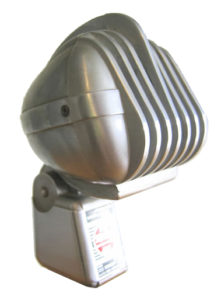
The Turner 33D is a vintage dynamic microphone that is… well, I mean c’mon, it’s frickin’ COOL! Granted, in an impulse response that means far less than it does live, but still. Where was I? Produced in the ’40s and ’50s, its 1920s Art Deco styling makes it hip to this day. Modern “bullet” mics for harmonica are modeled after its profile—it’s a bit heavy to cup in the hands itself but its form factor, sound and indestructibility make it popular with harp players nonetheless. The 33D definitely has a vintage lo-fi sound and brings an interesting character to drums and other instruments, and has been employed as a vocal mic by more recent acts like the Mesmers and the All-American Rejects.
Turner D-211
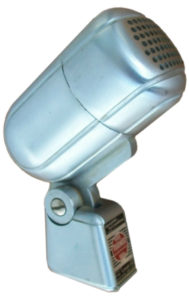
This high-Z dynamic microphone is another favorite of harmonica players, but is great in a wide variety of applications. It was designed to pick up an extended frequency range with a much better low frequency response than comparable mics in the ’40s, and to do that with lower harmonic and phase distortion than had previously been available on the market.
Western Electric 633A
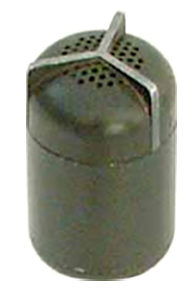
The “Salt Shaker,” as the Western Electric 633A was known, is a vintage microphone developed by Bell Labs as a high quality, low-impedence mic with a wide frequency range that was available at an affordable cost. It came with an acoustic baffle (not pictured, and not part of our gear) that slipped over the fins, changing the mic pickup from an omni-directional pattern to a uni-directional one. Despite its consumer-oriented pricing, its versatility made it popular with singers and radio broadcasters in the ’50s and ’60s, and was sometimes used as an overhead drum mic.
Zoom H6
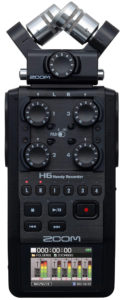
Zoom set the standard for field recorders in 2007 with the H2 Handy Recorder, with an omni mode that could be mixed down to 5.1 surround sound and fidelity so high that it was used for cultural preservation projects by everyone from Radio Free Asia to the Oral History Association to the Vermont Folklife Center. Several generations later, the stereo microphones that come with the H6 have even greater sensitivity and clarity, plus the addition of six-track recording and the ability to plug in four external mics or line-level inputs. We use it for recording environments as well as for capturing room sounds for speaker cab IRs.